Composition.
DOSAGE: 4 MINUTES
01 — THE NAME
Pia mater. Latin, twelfth century: the tender mother. It names the innermost of three membranes wrapping the brain and spinal cord, the layer that lies directly against the tissue itself, vascular, thin, and closer to the nervous system than anything else in the body gets to be.1
The name is older than the anatomy it now describes precisely. The tenth-century Persian physician al-Majūsī called the tough outer membrane umm al-qalīẓah, the thick mother, and the delicate inner one umm al-raqīqah, the thin mother, believing the meninges gave rise to every other membrane in the body, the way a mother gives rise to a child. In the twelfth century, the monk Stephen of Antioch translated the pair into Latin: dura mater, pia mater.2 Tender is not quite what raqīqah means. Antioch’s word probably should have been tenue, thin. He wrote pia instead, pious, tender, and pia is the word that stayed.
I took the mistranslation as a job description. A knitwear studio named for a filing error made nine hundred years ago, by a monk translating Arabic medicine into Latin, worn by people whose nervous systems keep excellent records. Correcting it would have made the name make sense on first reading. The name was never meant to.
02 — THE SYMBOL
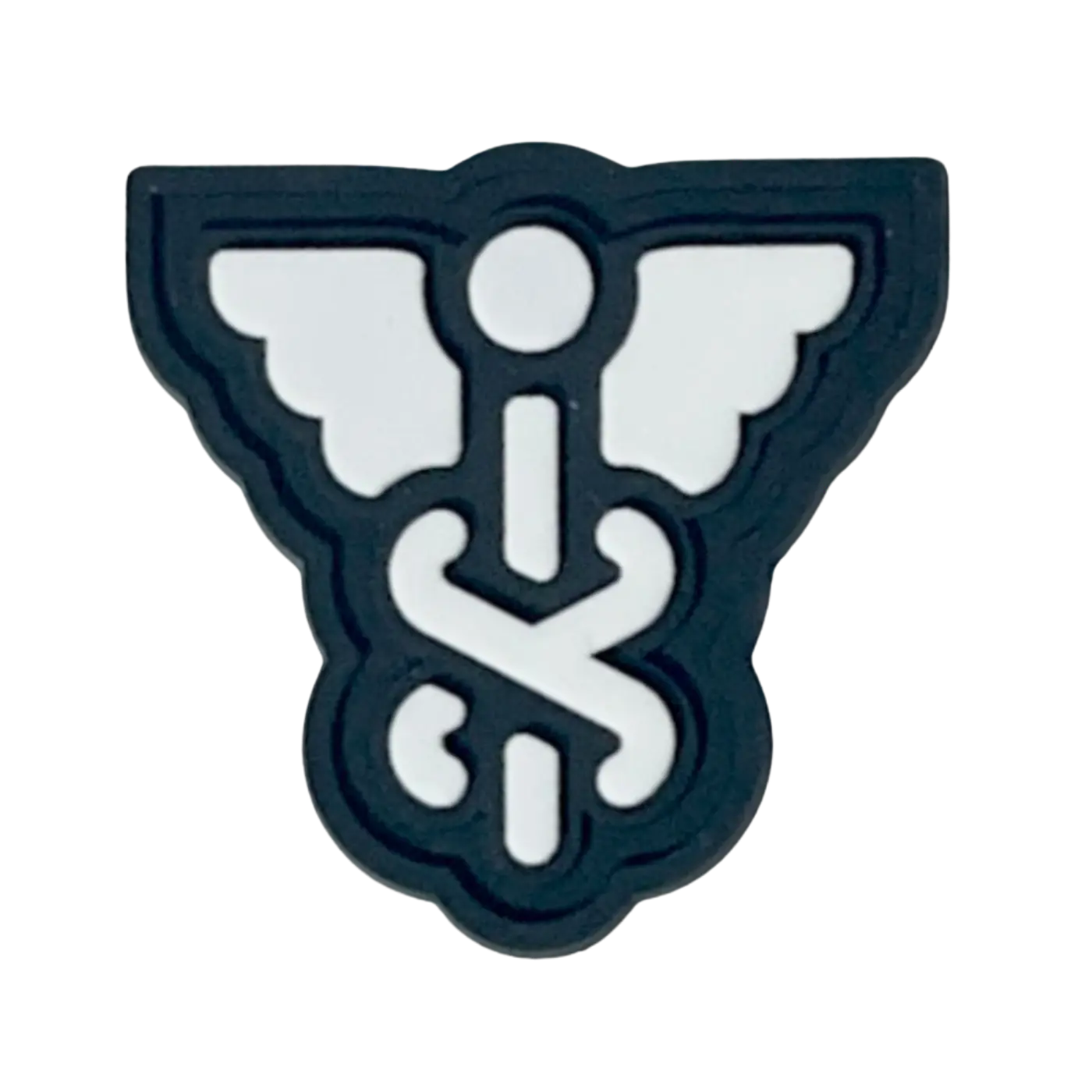
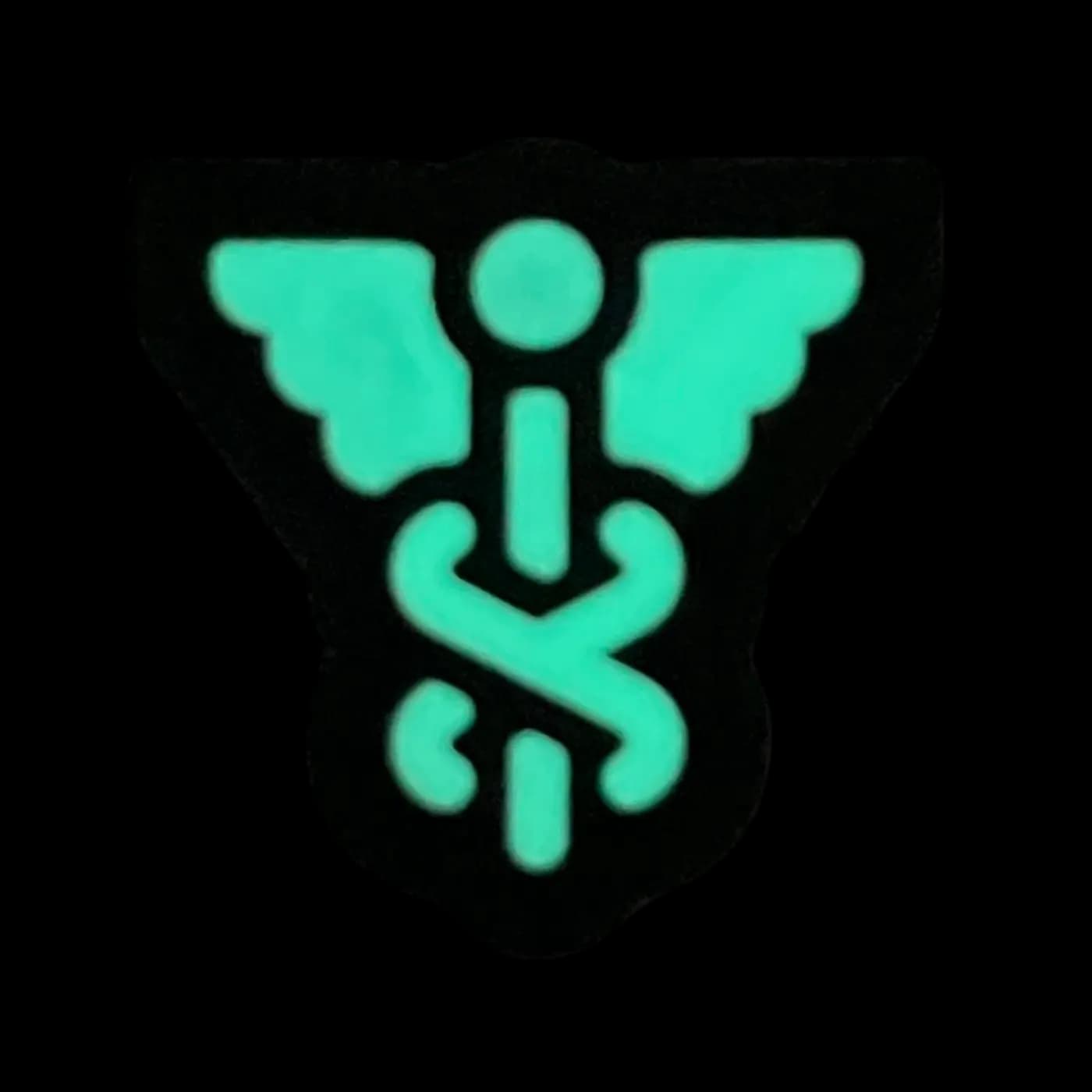
The mark is a caduceus: a winged staff, two serpents entwined around it, cast in black rubber and charged to glow in the dark. It is, technically, the wrong medical symbol.
The correct one is the rod of Asclepius: one serpent, no wings, belonging to the Greek god of healing. The caduceus belongs to Hermes, god of commerce, thieves, and messengers, and has nothing to do with medicine at all. The version hospitals and ambulances use in the United States today is not ancient either. It was popularised by a nineteenth-century medical publisher’s printer’s mark, adopted by the US Army Medical Corps in 1902, and mistaken for classical authority ever since.3
To me the two serpents are not medicine. They are life-force: two channels coiled around one spine, the nervous system’s own current.
03 — THE THESIS
What follows is the thesis, unedited since it was first written down. One piece of it deserves a citation the manifesto itself never gives: the nervous system’s own preference for slow touch. C-tactile afferents, a class of nerve fibre found only in hairy skin, fire hardest for stroking at walking pace, one to ten centimetres a second, and register less at any other speed.4 Wool, arranged by hand, slowly, is not a metaphor.
The pia mater is the innermost membrane of the brain. The tender mother. The softest layer, closest to the nervous system.
That is the job description.
I make hand-knit garments for people whose nervous systems keep excellent records. Superfine merino, measured in microns. Seams placed where they will not be noticed. No labels. A label is a design failure with a barcode. One neon accent. A symbol that glows in the dark, because dark times were the brief.
I do not make medicine. Medieval doctors prescribed conserve of roses for melancholy, and I name my work after their confidence, not their results. What I claim is smaller and true: wool, arranged carefully, by hand, for thirty-one hours, with your skin in mind the entire time. Better than leeches. The bar is historical, and I clear it.
There is no shop. Garments are knit singly, at the pace of two hands, and dispensed when they exist. Prescription only, by chance among the subjects they fit. I do not do countdowns, or last chances, or almost-gone. Scarcity here is not a strategy. It is arithmetic.
My symbol is the caduceus: the wrong medical symbol, sacred to the god of commerce and tricksters. I am, after all, selling you a jumper.
Admissions are open. The lights go out either way. This is what the glow is for.
04 — FOOTNOTES
- The pia mater is the innermost of the three meningeal layers, directly investing the surface of the brain and spinal cord. Adeeb N, Mortazavi MM, Tubbs RS, Cohen-Gadol AA. “The pia mater: a comprehensive review of literature.” Child’s Nervous System 2013;29(10):1803–1810. ↩
- “Tender mother” is a Latin rendering of the Arabic umm raqīqah, coined by the physician al-Majūsī and translated into Latin by Stephen of Antioch around 1127. Pia (“pious”, or “tender”) is generally held to be a mistranslation of the Arabic for “thin”, which has persisted for nine centuries regardless. Adeeb et al., 2013, as above. ↩
- The caduceus, a staff with two entwined serpents and wings, is the property of Hermes, god of commerce, thieves, and messengers. The correct medical symbol is the rod of Asclepius: one serpent, no wings. The medical caduceus in wide American use today does not descend from antiquity at all. It derives from the 19th-century printer’s mark of a medical publisher. Wilcox RA, Whitham EM. “The Symbol of Modern Medicine: Why One Snake Is More Than Two.” Annals of Internal Medicine 2003;138(8):673–677. ↩
- C-tactile afferents, a class of unmyelinated nerve fibre found in hairy skin, fire most vigorously in response to stroking at 1–10 centimetres per second. Subjects rate touch at exactly these slow velocities as the most pleasant. Faster or slower, the same fibres respond less. Löken LS, Wessberg J, Morrison I, McGlone F, Olausson H. “Coding of pleasant touch by unmyelinated afferents in humans.” Nature Neuroscience 2009;12(5):547–548. ↩
Sensorially plagued fashion designer, Limerick.
Trained at the Fashion Academy of Ireland (Diploma, Fashion Design). The medieval pharmacology is self-taught.